
By Darian Macey, November 18 2025
1407h – The CFI Q&A session has commenced. The first question from the floor is about the Guaranteed Maximum Price contract. Ese Rainey is explaining that the GMP contract template went live last month. There has been a training session provided to contract managers. This contract will be predominantly used for works above the Tropic of Capricorn.
1403h – Question from the floor about offshoring of design work. “Offshoring seems cheap” was the reply from Ms Dann, stating “We have a very strong preference for design work to be done onshore. We will risk-assess if you wish to offshore design work.”
1400h – As of this week, provisional conditional DISP membership is now available to businesses that have a MAP.
1353h – Question about funding available for security uplift via the Security Grant Scheme. The grant requires the applicant to have a Maturity Action Plan completed. With the deadline closing, Ms Dann advised companies to inform DISB if they need their MAP accelerated to meet the deadline.
1350h – Question from the audience about inconsistent demands from contract managers with respect to security requirements. Ms Dann agreed that contract manager training needs more work. Her organisation runs regular contract manager training.
1345h – AGSVA is currently managing almost 430,000 active security clearances. In FY 2024-25, AGSVA completed over 83,500 assessments. A baseline clearance currently takes an average of 16 days, and an NV1 and NV2 clearance takes 34 and 57 days respectively.
1341h – Ms Dann has explained that the DISP application backlog currently stands at 756. DISB is currently looking to double its application workforce to meet this demand. Average processing duration is 100 days.
1320h – Kate Dann has commenced the presentation on the Defence Industry Security Program with two recent examples of cyber attacks against Australian-based defence industry participants.
1240h – We’re breaking for lunch now. More to follow in about 40 minutes.
Brigadier Gabrielle Follett – Estate Appraisal and Upkeep
BRIG Follett shifted the focus upstream from the usual Estate Works Program (EWP) discussion to explain “the sausage machine that feeds the Estate Works Programme.” She emphasised that sustainment begins with estate appraisal — a nationwide, standards-based assessment that measures the condition, functionality and compliance of Defence assets across a vast and ageing portfolio: 24,000 buildings, 1,000 properties, 70 major bases and “over 1.6 million pieces of individual equipment.” These assessments, paired with estate upkeep activities delivered through EMOS and soon the Property and Asset Services contracts, form the evidence base that determines what work is required to keep the Defence estate safe, compliant and capable.
She explained that estate appraisal data feeds into the Prospective Estate Requirements List (PERL) — 82,000 items at the start of the year, now reduced to “a much lower number… one and a half times” which is then prioritised using a risk-based approach. About 95% of the EWP is generated from this data. Each year, the process culminates in the Estate Prioritisation Forum, where Defence determines what falls “above the line” (fundable) or “below the line” (not affordable). She stressed the volatility of this funding line: “Sometimes our budget changes… and that means that the line can get higher and higher throughout the financial year,” reducing deliverable scope. Equally, while she remains hopeful, she does not expect increases in the next 12–24 months.
BRIG Follett also outlined the shift to new base services partners, with all contracts signed and full transition occurring on 1 February 2026, replacing the EMOS model with Property and Asset Services, Living and Working Services, National Programme Services (JLL) and Project Delivery Services delivered by Aurecon, APP Group and Mott MacDonald. She acknowledged industry interest in rising project values within the EWP, explaining that cost escalation and agility needs mean some larger works will continue to be delivered through the EWP rather than CFI, particularly where the model offers “a little bit less administrative overhead.” Looking ahead, she wants to see the appraisal process modernised — “simpler, more technology-enabled and far less desktop” — and invited industry ideas to help Defence improve data quality, automation and configuration management as the estate becomes more complex and climate pressures grow.
1230h – Challenge to Industry: BRIG Follett is explaining the Prospective Estate Requirements List (PERL) and flagging that the annual estate appraisal process is incredibly laborious. She is keen to explore opportunities to use technology to modernise it and make it more of a continual assessment.
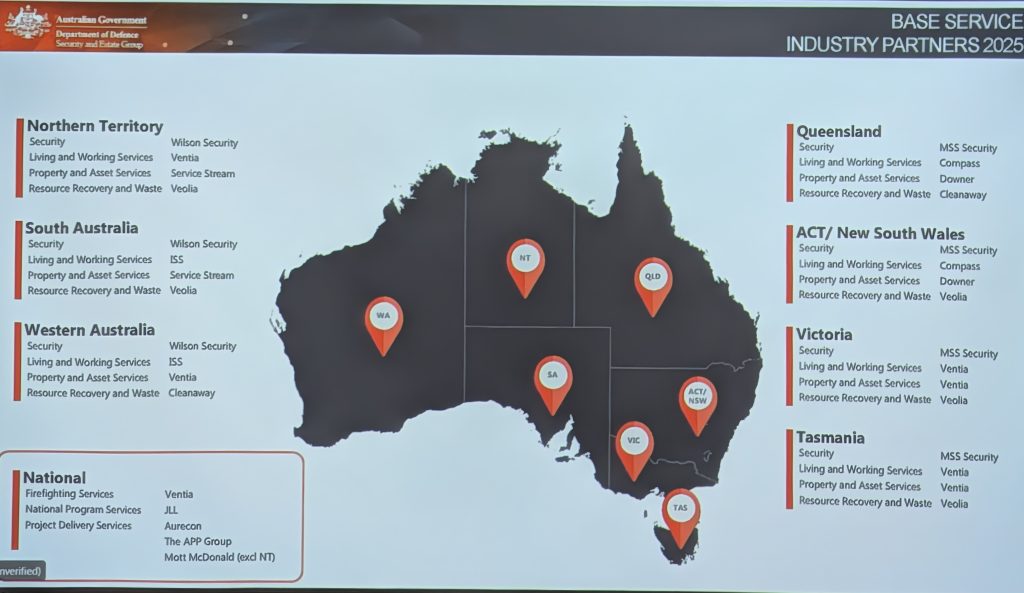
1214h – BRIG Gabrielle Follett is explaining the Estate Appraisal and Upkeep and how it informs the Estate Works Program.
1210h – That concludes the questions on the Major Capital Works Forward Works Program Update.
1208h – Interesting question from Mike Rinaudo (DT Infrastructure) re. MCs on the DIP-MC Panel releasing works packages vs trade packages. Ms Rainey stated that CFI has no position other than best value-for-money.
1205h – Ese Rainey stated that all procurements must consider if an indigenous business can deliver before approaching the DIP panel.
1157h – EST02043 Benalla/Mulwala – Shortlisted Companies: Acciona, Built, CPB, Icon and Seymour Whyte
1155h – ESTJ2087PH2B Australian Weapons Manufacturing Complex – Shortlisted companies: CPB, LOR, LL, MPX
1153h – EST02060 GIDP Sub-Program – CFI is in negotiation with a DSC. Works to be procured via 3-5 contract packages over a 10-year period, each valued at $200-400m. May be subject to EPBC referral.
1149h – ESTA6500PH1 Facilities to Support AIR6500 PACKAGE 2 (RAAF Williamtown, NSW) – Awaiting non-rejection of MPFR, slipped by 6 months due to government approvals, shortlisted companies: Hansen Yuncken, Icon, RCC, Seymour Whyte.
1144h – Facilities to Support Army Littoral Manoeuvre – no change to previous advice, no slide provided.
1140h – ESTz General Baker Complex HQJOC – Shortlist of contractors has been finalised, but was not announced. RFT will occur in Q1.
1138h – EST02039 Borneo Barracks Redevelopment Project has been delayed by 3 months.
1136h – A list of subcontractor opportunities has been displayed on the screen but not discussed.
1134h – EST02060 Chowder Bay Defence Fuel Installation (Maritime) – Changing from a competitive ECI to a HC (Construct Only).
1131h – ESTS4000PH6 Facilities to Support Hobart Class Destroyer AEGIS Baseline Upgrade – $100-$200m value at Randwick Barracks (NSW) and $5-$10m value at St Kilda (SA).
1128h – ESTL8180PH1 Facilities to Support Aviation Field Fire Truck Capability (Package 2) – fire fighting training simulator, delayed by 9 months.
1128h – ESTL8180PH1 Facilities to Support Aviation Field Fire Truck Capability (Package 1) – pad for the simulator, delayed by 9 months.
1124h – EST7000PH1B – Facilities to Support AIR7000PH1B Remotely Piloted Aircraft (Stage 2 – Hangar 564) – delayed 3 months due to change in procurement method, currently contemplating ECI HC.
1121h – ESTA7000PH2B-2C Facilities to Support Maritime Patrol Aircraft Replacement – procurement has slipped by 3 months, and changed from HC to MWC delivery.
1119h – Ese Rainey explained that there will be no further tenders released by CFI before Christmas.
1112h – Major Capital Works Program Overview
Morning tea has concluded and COL Karl Reynolds has taken to the stage in place of BRIG Matt Quinn who is currently in Darwin. COL Reynolds is outlining the current infrastructure programs and their links to capability.
Felix Bowman-Derrick – Defence Environment and Engineering Update
Felix opened by outlining the significant policy shifts across government that are shaping Defence’s environmental and engineering priorities. He pointed to the updated emissions targets announced in September — a 62–70% reduction by 2035 — calling it “a very clear signal… that we will need to participate in that emissions reduction journey and contribute.” He highlighted the first national climate change risk assessment and adaptation plan, noting that the impacts on northern Australia — hotter temperatures, extreme weather, sea level rise — are “made very stark in black and white.” These whole-of-government changes, combined with the upcoming 2026 National Defence Strategy, are driving the focus on environmental approvals, climate adaptation and clean energy across the Defence estate.
He then moved to Defence’s Net Zero Strategy, released just over a year ago, which sets targets of 43% reduction by 2030 and net zero by 2050. Felix reported that Defence’s emissions last financial year were 2.1 million tonnes, representing a 3% reduction, but stressed that “there is quite a long way to go.” The biggest opportunities lie in clean energy, energy efficiency and solar generation — particularly in northern Australia, where off-grid bases rely heavily on diesel. Projects such as the Mulwala renewable energy project, the Tindal solar farm procurement, and progress at Hart’s Range show momentum building. He also noted that Defence, as the Commonwealth’s largest landholder and energy user, carries disproportionate scrutiny: “Two thirds of what [Finance] reports is Defence’s emissions… the spotlight is on Defence.”
Felix closed with a forward look at major reforms underway within Environment and Engineering Branch. Over 4,000 pages of engineering and environmental policy are being consolidated into two clearer manuals — a new Defence Environmental Manual and a new Estate Engineering Manual — with release targeted for early 2026. The intent is to simplify requirements, align more closely with the National Construction Code, and provide consistent guidance for environmental approvals nationwide. He also highlighted work to modernise heritage management, shifting toward a more pragmatic balance of “a safe, secure, fit-for-purpose estate” while still respecting heritage values. A strong push on clean energy will continue into next year, with northern bases “getting more traction” due to the dual benefits of resilience and reduced diesel reliance.
1036h – Lots of questions on Slido about the policy manuals.
1031h – Mr Bowman-Derrick outlined a number of energy-related projects, including a solar farm at Tindal for which procurement is underway, and another at Mulwala that is breaking ground this week.
1027h – Felix Bowman-Derrick is discussing environment and engineering.
Amelia Charlton – Estate Planning Update
Amelia Charlton’s brief focused on how Estate Planning is shaping Defence’s long-term infrastructure posture, particularly as the next National Defence Strategy (NDS) and Integrated Investment Program (IIP) updates approach. She explained how her branch sits within the broader One Defence Capability System, bridging strategic design and investment delivery. Amelia highlighted the shift away from the old first- and second-pass model toward a tiered complexity framework, noting that keeping EEIP projects in the “simple or low-complexity” categories allows Defence to “deliver quicker and get those elements delivered across the estate.” She also outlined the ongoing Integrated Capability Assessment process, emphasising that its goal is evolutionary rather than a repeat of the complete IIP rebuild completed in 2024.
A key part of her update was the Capability Integration Plan being piloted at RAAF Base Learmonth, driven by the recognition that multiple capability projects were competing for space, workforce and sequencing at the same location. Amelia explained that Defence needed to step back and ask: “How are we actually going to deliver this capability at Learmonth… and support partner forces at the site?” The plan aims to reduce duplication, manage delivery risk and establish a more coherent path for future basing decisions. She noted that similar thinking is guiding regional plans for North West Cape and Northern Queensland, where Defence is working more closely with state and territory governments to understand overall demand signals, align investments and identify where collaboration can stretch limited funding further.
Looking ahead, Amelia highlighted several strategic tasks for the next 12 months: finalising the Defence Estate Strategy, progressing the SEG Functional Review, strengthening estate resilience policy and reviewing investment prioritisation settings. She stressed that “money is finite,” so Defence must explore innovative pathways beyond traditional delivery models, while gaining a clearer understanding of risks across the estate and their impact on strategic decisions. Amelia also confirmed she is open to broader industry involvement — including the Major Construction Services Panel — noting “we can’t do things how we’ve always done them” and encouraging direct engagement with her office to explore new ways of planning and delivering estate capability.
1015h – Amelia Charlton has taken the stage for the Estate Planning update. She has begun by outlining the One Defence Capability System, something much of the industry struggles to comprehend.
Pat Sowry – Strategic Estate Update
Pat Sowry’s Strategic Estate Update set out a clear picture of how SEG’s infrastructure division is structured and how its different branches connect into Defence’s broader strategic priorities. He began by outlining the roles of the key branches under his remit — Capital Facilities and Infrastructure, Environment and Engineering, Estate Planning, PFAS Investigation and Management, and the newly formed Maritime Infrastructure and Integration Branch. Pat emphasised the growing weight of the maritime domain, noting that around 38% of the Integrated Investment Programme now sits in maritime-related infrastructure, with major commitments spanning Stirling, (Submarine Rotational Force West), Henderson, and broader Navy disposition planning. He also welcomed the arrival of Helen Loundes, who will lead the maritime branch and help coordinate efforts across several large naval programs.
He then turned to the practical question most in the room were thinking about: how to get involved. Pat walked through the pathways for industry engagement, reinforcing that planning, design and delivery operate through an outsourced model using project managers, designers, managing contractors, head contractors and specialist sub-panels depending on scope. He encouraged companies to track opportunities on AusTender, attend briefings like today’s, and build relationships with panel members, particularly those recently appointed to the new Major Construction Services Panel. He also linked current priorities directly back to the National Defence Strategy, highlighting three top focus areas: submarine infrastructure, the Guided Weapons and Explosive Ordnance enterprise, and the Northern Base Resilience program. Pat noted that Defence is seeing fewer but larger and more complex projects, and that financial management pressure across Defence is now more acute because nearly every division is meeting its spending targets — creating real constraints in-year.
Finally, Pat addressed innovation, acknowledging that while industry regularly approaches Defence with new products, designs and methodologies, very few of these innovations make it through to delivery. He asked industry to be frank about what is blocking progress — whether tender documentation, policy settings, risk tolerance or security rules. He signalled a genuine appetite within SEG to accept more risk when the payoff is worthwhile, noting the shift toward speed, resilience and adaptable design across northern bases. Pat also discussed alternative financing, explaining that while ministers are interested and a new assessment framework is in place, most proposals struggle due to timing constraints, parliamentary approval requirements and the absence of revenue streams within Defence estate assets. He closed by reaffirming that despite budget constraints and strategic pressures, the pipeline remains substantial — and SEG wants industry to stay closely engaged as planning for the 2026 National Defence Strategy and IIP update continues.
1001h – Q&A with Pat Sowry is lively as always. Slido is getting a steady stream on questions. Brendan Sowry, has kept to tradition by being first to ask a question of his brother.
0957h – Loving the use of AI-generated images in today’s presentations. Imitation is the highest form of flattery, as they say.
Celia Perkins – Opening Address
Celia Perkins opened the session by acknowledging the scale and diversity of the room and reinforcing why SEG holds these industry briefs twice a year. She noted that attendance continues to grow, both in person and online, reflecting the increasing importance of Defence estate delivery and the strong engagement from project managers, builders, environmental specialists and subcontractors. She framed the forum as a partnership exercise: a chance for Defence to share clarity on upcoming priorities and for industry to ask questions, strengthen networks and understand how to work more effectively with SEG.
She then set the strategic context, outlining the three major estate programs overseen by SEG — the Enterprise Estate and Infrastructure Program, the Estate Works Program and routine maintenance under the Estate Upkeep framework. She linked SEG’s work directly to the National Defence Strategy and the Integrated Investment Program, highlighting the shift toward an integrated force and the emphasis on northern base resilience. Celia pointed to major progress across key sites such as Tindal, Darwin, Stirling, Cairns, Townsville and various southern bases, emphasising that current investments are already delivering visible benefits across the estate.
Looking ahead, she noted that the next iteration of the National Defence Strategy and the updated IIP are already in development for release next year. She acknowledged industry’s concerns around budget rules, compressed timelines and forecasting pressures, and she stressed that Defence wants to stay closely aligned with delivery partners to navigate these constraints together. Celia also addressed the recent fraud case in Darwin, making clear that it is an active investigation and that Defence personnel cannot comment. She closed by addressing the news from Darwin about the arrest of a member of her group last week on charges of fraud, urging industry to maintain professionalism, avoid speculation, and use the day to engage openly with SEG leaders — on every topic except the one before the courts.
0950h – Financial management
Mr Sowry states that “Everyone is achieving their targets, which puts pressure on in-year budget that has a flow-on impacts to capability.” He says forecasting within the division improved.
0945h – Commentary on the Integrated Investment Plan
Reassessment of the investment program: Don’t anticipate huge changes with the new IPP – “an evolution, not a revolution”.
0935h – Pat Sowry – Strategic Estate Update
Mr Sowry is explaining changes to the org charts at SEG and Infrastructure Division, and discussing ways to join the supply chain, speaking directly to those new to the sector.
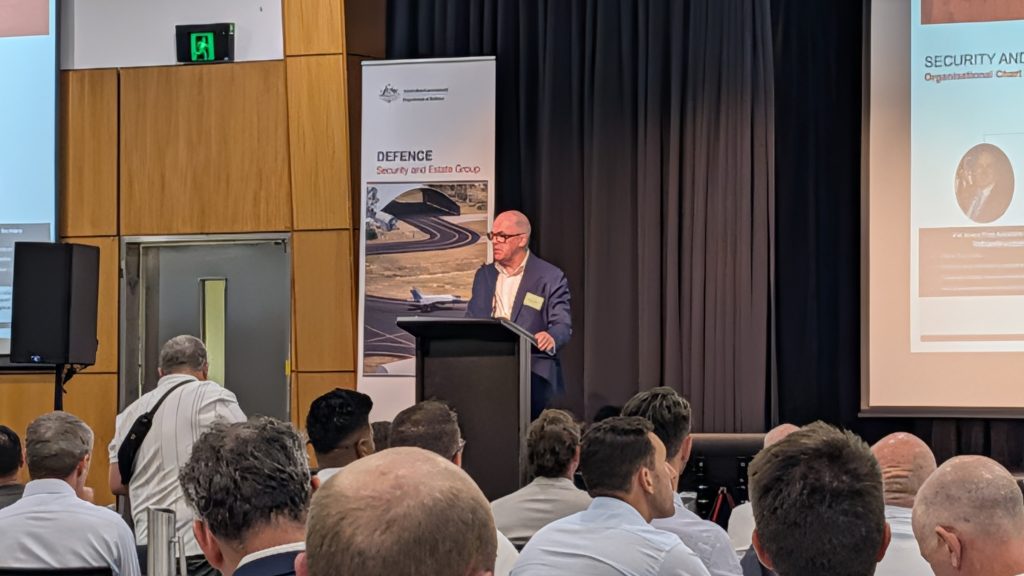
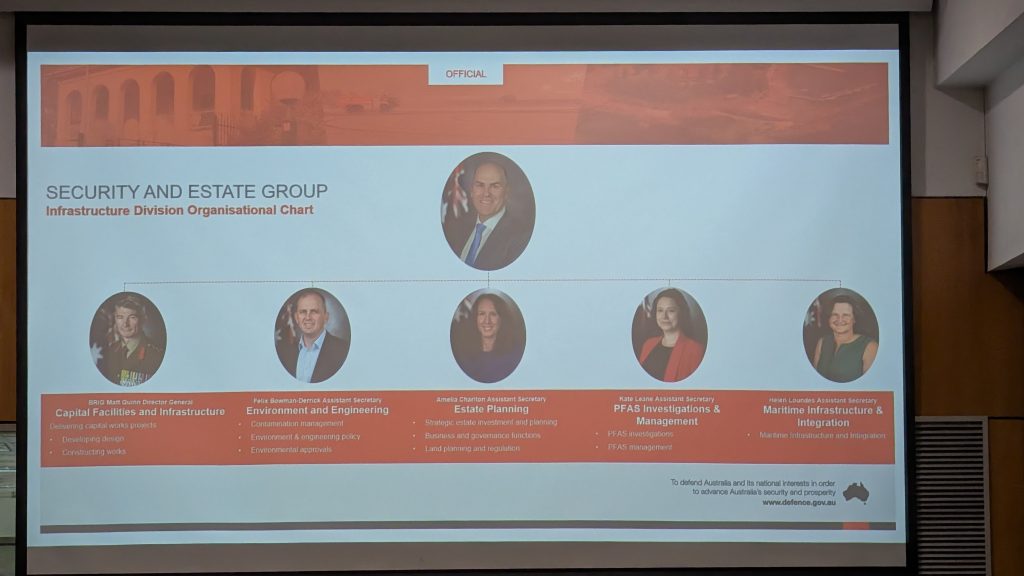
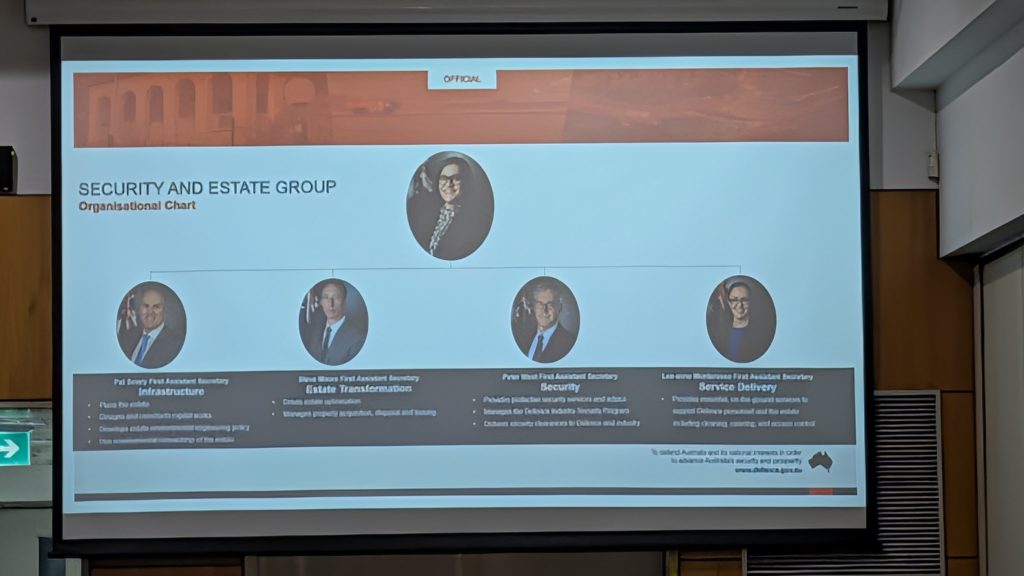
0930h – Strategic Updates
NDS 2026 and a recut of the IIP expected early next year. New budget rules have made it difficult to manage project budgets in-year.
Ms Perkins has addressed the elephant in the room regarding the news from the NT over the weekend, asking the audience to leave it to the police and not to ask any of her staff about it.
0920h – Celia Perkins, Deputy Secretary Security and Estate
Ms Perkins has opened by outlining SEG’s priorities, including HMAS Stirling, GWEO and Northern Bases. The Estate Audit is expected to be released in the new year.
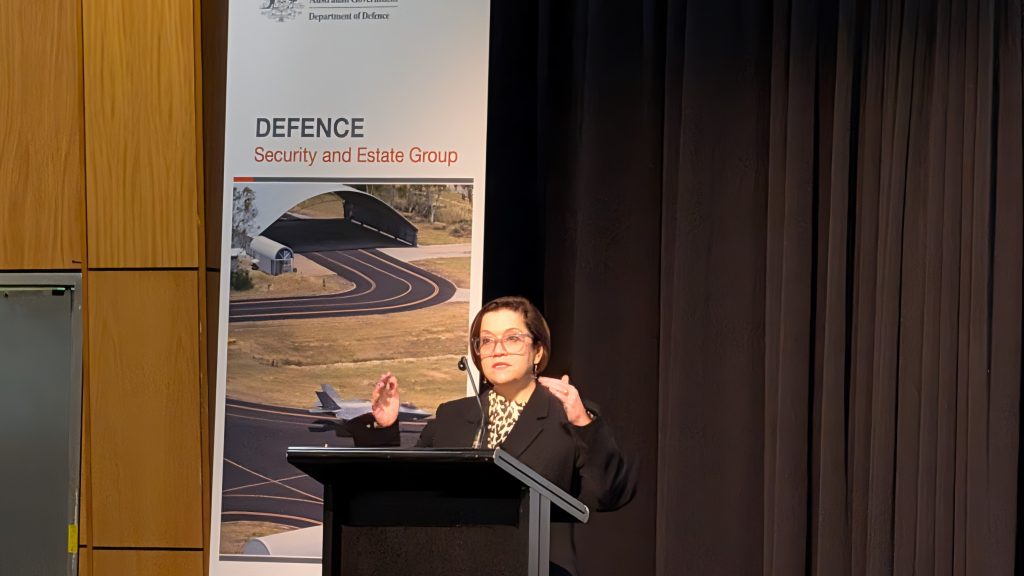
0910h – Briefing commenced
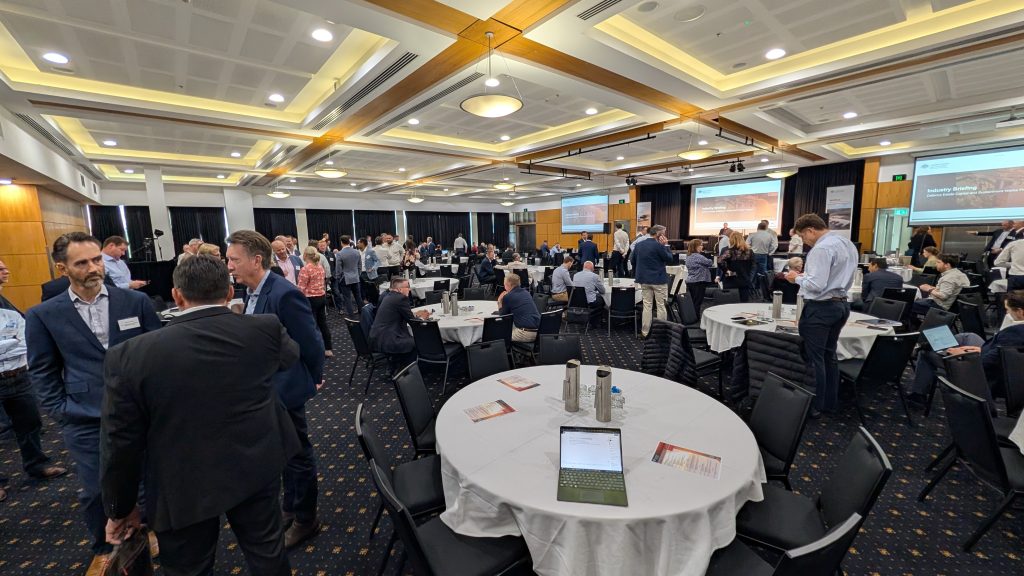
The room is assembled, and Holly is giving a brief on the use of Slido. Here’s a quick, rundown of what’s ahead today so readers know how the brief will unfold.
Today’s Agenda – What’s Coming Up
We’re set for a full sweep across the Defence estate, from long-range strategy through to program sequencing and industry security. Key segments include:
- A welcome from Holly Lowe, followed by opening remarks from Deputy Secretary Celia Perkins – setting the tone for the day and outlining SEG’s priorities.
- A strategic look at the estate from Pat Sowry, covering pressure points, emerging demands and where Defence is shifting its focus.
- An update on estate planning from Amelia Charlton, shaping how future works are prioritised and prepared.
- A dive into environmental and engineering themes with Felix Bowman-Derrick – an area that continues to shape scope, cost and delivery settings.
- COL Karl Reynolds stepping through the Major Capital Works Program overview before joining Ese Rainey and LTCOL James Dugdell for the procurement forward works update – always a key moment for industry.
- BRIG Gabrielle Follett explaining how estate appraisal and upkeep feed directly into the Estate Works Program and influence regional workloads.
- Kate Dann outlining developments in the Defence Industry Security Program – increasingly important as project complexity rises.
- A Q&A session with Holly Lowe, giving the room (and Slido) the chance to surface issues and clarifications.
0855h SEG Industry Brief – Live Commentary Begins
Thanks for joining. I’ll post updates here as the session progresses.
I’ll keep each update short and focused on what matters for designers, contractors, and service providers in the Defence estate.

Author: Darian Macey
Darian is a former Engineering Officer with the RAE with tertiary qualifications in Engineering and Project Management. He is a leading practitioner within Australia's NSI sector with previous employment in Government, project management and building contractor organisations.


