By Darian Macey, March 2 2025
Course Overview:
This program is designed for industry professionals seeking a structured learning experience to enhance their understanding of Australia’s Defence Estate, improve their bid strategies, and build long-term relationships within the Defence infrastructure sector. Each week, new content will be made available on decnet.com.au, accompanied by an email notification.

Learning Objectives:
By the end of this program, participants will be able to:
- Understand the structure, strategy, and key stakeholders of Australia’s Defence Estate.
- Develop compelling Defence Capability Statements and winning bid strategies.
- Navigate the Defence procurement landscape, including contracts, risk management, and compliance.
- Implement business development strategies that maximise engagement with Defence stakeholders.
- Gain insights into major Defence infrastructure programs and opportunities.
- Build and manage long-term customer relationships using CRM tools and data-driven insights.
Course Structure:
The program is divided into five key phases, ensuring a logical progression from foundational knowledge to advanced strategies.
Phase 1: Introduction to Doing Business on the Defence Estate (Weeks 1-5)
- Week 1: Introduction to Defence Infrastructure
- How is the Defence Estate structured, governed, and managed?
- Who are the key government bodies, programs, and decision-makers
- What is the role of the Security and Estate Group (SEG)?
- What are the strategic influences shaping the Defence Estate?
- How do the key procurement mechanisms work?
- How can businesses engage with Defence?
- Week 2: Presenting Your Defence Capability
- Start with Why: How to articulate your business value proposition
- How to align with ADF Values
- How to approach Defence Industry Security Program (DISP)
- How to approach social impact including veteran & indigenous participation and sustainability
- How to establish credibility through testimonials & existing relationships
- Capability Statement Checklist
- Week 3: Screening and Strategic Positioning
- How to evaluate opportunities early-on
- How to identify win themes aligned to Defence priorities
- How to assemble a bid team effectively
- How to develop a realistic bid budget
- How to mitigate financial risk
- Week 4: From Bid Strategy to Submission – Mastering Defence Tenders
- What Do Defence Tender Evaluation Boards (TEBs) Look For?
- Understanding the end-to-end bid process
- How To Build a Methodology
- How To Demonstrate Credibility (presenting key resources and past performance effectively
- How To Demonstrate Value for Money (VfM)
- Week 5: Cost Transparency and Trust in Defence Tendering
- How to accurately complete Defence cost schedules to avoid hidden costs.
- How to confidently navigate Defence tender negotiations.
- How to build trust using clear storytelling in your tender.
Phase 2: Risk & Contract Management (Weeks 6-10)
- Week 6: Understanding Project Risk – An Introduction
- Overview of risk management
- Importance of effective risk management in Defence infrastructure
- Introduction to the Defence Infrastructure Project Risk and Contingency (DIPRAC) framework
- Overview of the eight categories of project risk: Coordination, Environmental, Location, Stakeholder, Information, Technical, Delivery, Contractual
- Week 7: Geographic and Environmental Risks
- Understanding location-specific challenges
- Managing risks related to remote sites, logistics, climate variability
- Assessing and mitigating environmental impacts (e.g., contamination, heritage, biodiversity)
- Case study insights and practical applications
- Week 8: Stakeholder and Coordination Risks
- Managing diverse stakeholder expectations and interests
- Effective stakeholder engagement strategies
- Coordination across multidisciplinary teams and complex projects
- Practical tools for communication and collaboration
- Week 9: Technical and Delivery Risks
- Identifying technical complexities and engineering challenges
- Strategies for managing risks related to technology integration, budget constraints, and ambitious timelines
- Dealing with supply chain disruptions and workforce availability
- Practical scenarios and risk mitigation approaches
- Week 10: Contractual and Information Risks
- Recognising the impacts of contract conditions (e.g., unlimited liability, fitness for purpose)
- Techniques for risk distribution and balanced contractual agreements
- Strategies for managing risks associated with insufficient or unreliable project information
- Guidelines for contingency planning and adjustments based on calibrated questions and benchmarking
Phase 3: Business Development & Market Positioning (Weeks 11-17)
- Week 11: Sales Funnel & Relationship Audit
- How to structure a Defence-specific sales funnel from Awareness to Retention
- The five stages of Defence business development
- How to conduct a relationship audit and uncover key gaps
- Tools for stakeholder mapping and prioritising Defence decision-makers
- Week 12: Brand Building & Outreach
- How to approach new Defence contacts through cold calls, emails, and LinkedIn
- Building credibility through social proof—testimonials, case studies and thought leadership
- Optimising your brand visibility to attract Defence decision-makers (LinkedIn, website, conferences)
- Best practices for timing, tone, and follow-up in Defence business outreach
- Week 13: Post-Submission Follow-Up
- How to schedule and script persuasive follow-ups post-submission
- What to say after “no response” and how to re-engage decision-makers
- Managing rejection: getting the debrief and improving your chances next time
- Using your CRM to automate and track follow-up cycles
- Week 14: Pre-Tender Engagement Strategies
- What is market sounding and why it gives you an edge
- How to approach Defence and PMCA contacts before the RFT
- Structuring your input during ITR/EOI/industry briefings
- Meeting etiquette, pitch tactics, and influencing scope
- Week 15: Capture Planning – Securing Work Before It’s Released
- Capture Planning 101: concepts, timelines, and team roles
- How to track upcoming Defence projects (12–36 month horizon)
- Building intelligence around competitors and Defence preferences
- Positioning your business as “the safe pair of hands”
- Week 16: Building Key Relationships Before the Tender Drops
- How to map key players—PMCA, Design Consultants, MCs, SMEs, Defence sponsors
- Structuring BD meetings for maximum impact
- Elevating your business from “unknown” to “preferred”
- Using LinkedIn and DECNet to network effectively
- Getting introduced the right way (warm referrals, not cold DMs)
- Week 17: Strategic BD Positioning & Long-Term Success
- How to sustain your BD momentum across financial years
- Positioning for multi-year panels, standing offers, and preferred supplier lists
- Adapting to Defence’s evolving investment priorities
- The BD Roadmap – balancing short-term wins with long-term positioning
Phase 4: Defence Major Programs (Weeks 18-26)
- Week 18: AUKUS Infrastructure – Stirling, Henderson & Osborne
- Infrastructure transformation to support nuclear-powered submarines
- Key stakeholders: ASA, ANI, NSSG and SEG’s Capital Facilities Branch
- Stirling (operations), Henderson (maintenance), Osborne (construction)
- Project scopes, delivery models and parliamentary approvals
- Week 19: Navy Sustainment – Garden Island & National Maritime Maintenance
- Garden Island Defence Precinct upgrade strategy (Sydney)
- EST02146 National Maritime Infrastructure Maintenance Program
- Regional Maintenance Centres and industry engagement pathways
- Infrastructure-led sustainment and supply chain access
- Week 20: Army Infrastructure – Littoral, Special Forces & Aviation Capability
- Littoral Manoeuvre Force: new waterfront and training facilities
- Special Operations precincts at Campbell, Holsworthy and Swanbourne
- Expansion of land force infrastructure: logistics, training, ranges
- Week 21: Infrastructure Backbone of Army Modernisation
- Army Aviation Program of Works in Townsville and Oakey
- Robertson Barracks Base Improvements Program
- Keswick Barracks Unit Relocation
- Combat Vehicle Facilities to Support Land 400 etc
- Riverina Redevelopment
- Week 22: Air Programs – Surveillance, Air Transport & Electronic Warfare
- Infrastructure upgrades at Learmonth, Curtin, Darwin, Amberley, Tindal and Richmond
- Supporting platforms: Wedgetail, Poseidon, C-17, KC-30A and Growler
- Hardstand, hangar, runway and fuel infrastructure programs
- Estate implications of Air Force posture modernisation
- Week 23: Joint & Space Programs – Logistics, GWEO & C4ISR Infrastructure
- Joint logistics and Theatre Enablement: Richmond, Edinburgh, Amberley
- GWEO infrastructure: storage, integration, testing and sustainment
- Space estate requirements: command centres, ground stations, radar
- Cross-domain enablers for ADF force projection
- Week 24: Strategy, Policy and Industry Group (SP&I) – IPACE
- Role of SP&I in shaping Defence’s global and regional infrastructure posture
- Indo-Pacific Infrastructure Initiatives
- How industry can align with SP&I priorities through infrastructure, innovation, and presence
- Week 25: US Force Posture Initiatives (USFPI)
- Joint infrastructure developments with the U.S. in NT and QLD
- Key projects: RAAF Tindal, Robertson Barracks, Bradshaw Training Area
- Funding structures, bilateral governance and delivery frameworks
- Opportunities for local industry under U.S.–Australia agreements
- Week 26: Australia–Singapore Military Training Initiative (ASMTI)
- Training area expansion and facilities construction in QLD and NT
- Shoalwater Bay and Mount Bundey precinct upgrades
- Bilateral estate access agreements and co-investment models
- Industry participation and social impact management
Phase 5: CRM & Business Growth (Weeks 27-30)
- Week 27: CRM Setup & Implementation
- Week 28: Key Account Management & Customer Relationship Strategies
- Week 29: Measuring BD Success – KPIs, CRM Metrics & Performance Tracking
- Week 30: Networking & Industry Engagement – Making Connections That Matter
- Final Case Study & Certification
Delivery Method:
- Weekly Content Drops: Each Monday, a new topic will be released.
- Multi-Format Learning: PDFs, checklists, templates, videos, Miro boards.
- Community Engagement: Members can discuss content via DECNet forums and LinkedIn groups.
- Quarterly Webinars: Live Q&A sessions with industry experts.
Assessment & Certification:
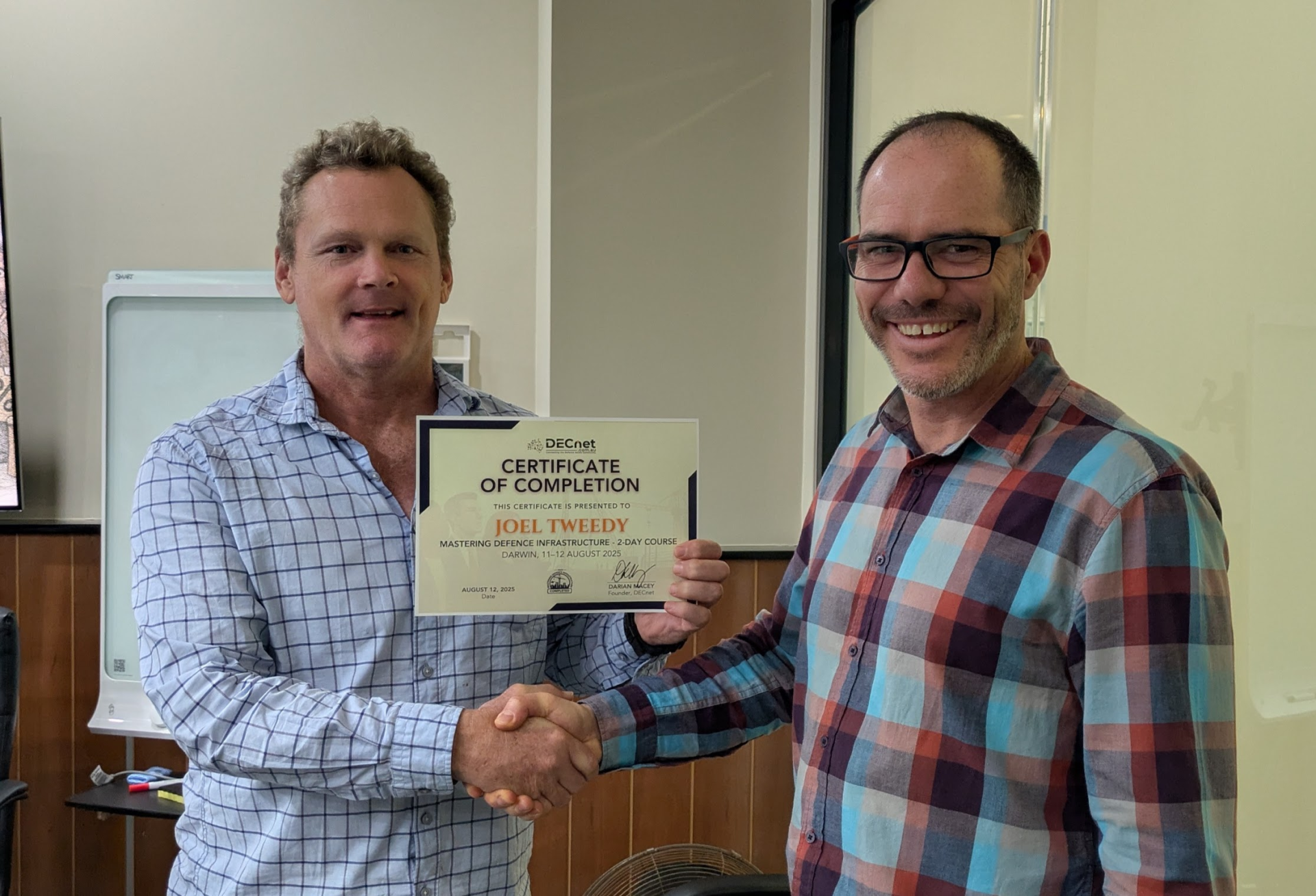
- Participants will receive a certificate upon completion of all modules.
- Optional self-assessment quizzes at the end of each module.
Final Notes:
This course is tailored to industry professionals seeking to expand their Defence infrastructure expertise. It is designed to be practical, actionable, and directly applicable to real-world business development and contract engagement in Defence. This course is exclusive to DECNet Pro Members.

Author: Darian Macey
Darian is a former Engineering Officer with the RAE with tertiary qualifications in Engineering and Project Management. He is a leading practitioner within Australia's NSI sector with previous employment in Government, project management and building contractor organisations.