By Darian Macey, October 20 2026
Defence has earmarked five major infrastructure priorities for potential alternative finance delivery, bringing its ambitions to attract different sources of capital into sharper focus.
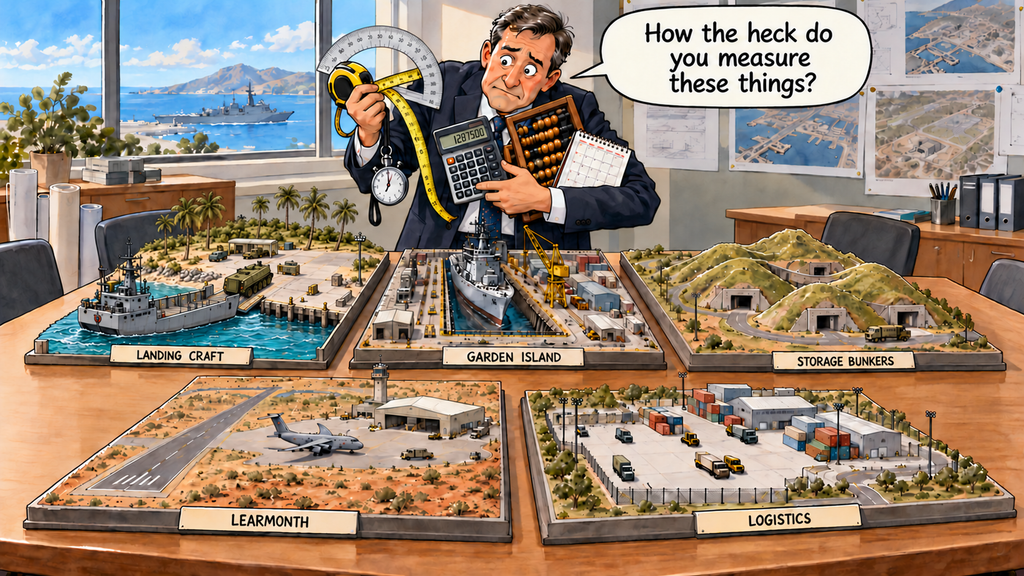
The list spans landing craft facilities in Queensland and the Northern Territory, Sydney’s Garden Island Defence Precinct, new explosive ordnance storage near Perth, further development at RAAF Base Learmonth, and logistics nodes in Alice Springs and Central Queensland.
For contractors, consultants, developers and investors, the significance extends beyond the works themselves. If alternative finance proceeds, it could change how projects are packaged, who assembles the delivery teams and where businesses need to build relationships.
The AusTender notice, AZ6635, was published on 29 September with a listed closing time of noon ACT local time on 7 October 2026. Despite its market-sounding title, Defence explicitly said it was not seeking proposals. The notice provides early visibility of projects under assessment and makes no commitment to a procurement, delivery model or project outcome.
Where the $15 billion fits
The 2026 National Defence Strategy identifies approximately 5 billion over the forward estimates and15 billion over the decade in projects for which Defence will prioritise developing alternative financing options.
That is a broader Defence investment figure. It is not a published valuation of the five infrastructure project groups in this notice, nor an approved $15 billion construction package.
Defence’s 2026 NDS budget factsheet also makes clear that alternative financing covers more than private capital. It can include equity investment through Commonwealth bodies, special investment vehicles and government business enterprises, as well as private financing.
At the Defence and Industry Conference on 1 July, Defence Industry Minister Pat Conroy identified the estate, infrastructure supporting capability and long-term service provision as areas of opportunity. He cited Bungendore as an existing example of using patient capital.
AZ6635 now puts specific infrastructure projects against that policy direction.
The five project groups under consideration
The notice identifies the following candidates. Its scope descriptions remain subject to Defence’s assessment and any subsequent procurement decisions.
| Project | Location | Scope described in the notice |
| LAND8710PH5 Littoral Manoeuvre Facilities | South-east Queensland, northern Queensland and the Northern Territory | Maritime facilities for berthing, mooring and vessel loading and unloading, alongside offices, living-in accommodation, homeporting, training and other base support facilities. |
| EST02060 Garden Island Defence Precinct | Sydney, NSW | Modernisation and remediation of critical infrastructure, including the Captain Cook Graving Dock; refurbished and new working accommodation; workshop improvements; quality-of-life facilities; and supporting infrastructure. |
| ESTJP2092PH1 GWEO Storage Program of Works — WA Deep Storage | Perth region, WA | Approximately 10 earth-covered explosive ordnance storage buildings, an ammunition processing building and supporting site works. A preferred location has not been identified. |
| ESTW6 RAAF Base Learmonth | Learmonth, WA | Further improvements to base resilience and supporting facilities, following projects already in delivery. Planning is at an early stage and the scope is yet to be determined. |
| ESTJP8218 Theatre Logistics | Alice Springs, NT, and Central Queensland | Logistics infrastructure, including hardstand, roads, freight access and security; temporary workforce accommodation and site services; and developable land. This project has a separate market-sounding notice, RFI/2026/ASCQ. |
The logistics nodes were the subject of DECNET’s September article. Their inclusion here connects that separate engagement with Defence’s wider alternative finance assessment. Each project’s own notices and documents will still determine its requirements and procurement pathway.
How alternative finance could change delivery
One possible approach is a public–private partnership, bringing some combination of design, construction, finance, maintenance and operation into a long-term arrangement. The Department of Finance’s PPP guidance describes performance-linked payments and allocating risks between the Commonwealth and private participants.
Other financing structures may suit different projects. AZ6635 does not select a model for any of the five groups.
Which begs the question: A new logistics site, an operating naval precinct and a remote air base present different requirements for land, access, security, maintenance and operational control. A structure that works for one may be unsuitable for another.
Private finance also has to be paid for. Spreading payments over time creates future commitments, and the case must stand up on delivery performance, risk allocation and cost over the asset’s life. Finance’s guidance recognises that PPPs can take longer to prepare and involve higher transaction costs than conventional procurement. Alternative finance does not automatically mean faster or cheaper delivery.
What industry should do with this information
DECNET’s assessment is that the immediate task is to understand how credible teams could form around each project.
For major contractors, that means considering relationships with developers, capital providers and asset managers alongside the usual design and construction partners. If a project includes long-term maintenance, decisions about materials, systems and access for servicing will carry consequences well beyond practical completion.
For consultants and specialist suppliers, the potential work reaches into site investigations, planning, environmental approvals, security, utilities, cost planning and asset management. The route to appointment could run through a consortium or development partner, depending on the model Defence eventually chooses.
For smaller firms, selectivity matters. Identify the project where your capability solves a specific problem, then establish which organisations could bring the wider team together. A generic capability statement gives a potential partner little reason to involve you.
There are also practical differences to track. Garden Island’s scope raises questions about delivering works within an operating precinct. The WA storage project still requires a preferred location. Learmonth’s scope is being developed. These matters will shape both the opportunity and the risks a team could reasonably accept.
Follow the decisions that turn a candidate into an opportunity
The next useful signals will be decisions on scope, sites, delivery models, approvals and procurement timing. Until those emerge, inclusion in AZ6635 should be treated as evidence of assessment rather than a forecast of construction revenue.
Use the Helyx Alternative Finance watchlist as the starting point for following this emerging pipeline. Read project updates alongside their source notices, particularly where a separate engagement or procurement is underway.
For businesses positioning early, the question is whether they can contribute to a workable delivery proposition. Finance, land, construction and long-term performance may all need to come together before these candidates become contracts.
Notice enquiries: Capital Facilities and Infrastructure Branch, defence.industry.engagement@parthenon.ey.com.

Author: Darian Macey
Darian is a former Engineering Officer with the RAE with tertiary qualifications in Engineering and Project Management. He is a leading practitioner within Australia's NSI sector with previous employment in Government, project management and building contractor organisations.