By Darian Macey, April 2 2025
Defence R&D headlines often spotlight jets, ships, and missiles – the flashy aerospace and combat platforms. Yet a quieter revolution is underway in the infrastructure of Defence: modular data centres, advanced port access systems, rapidly deployable secure facilities, and more. These “less glamorous” innovations underpin military capability by enabling faster deployments, improved resilience, and cost-efficiencies on bases and facilities. Unlike aerospace projects that garner public attention and funding, infrastructure innovation has been under-recognised.
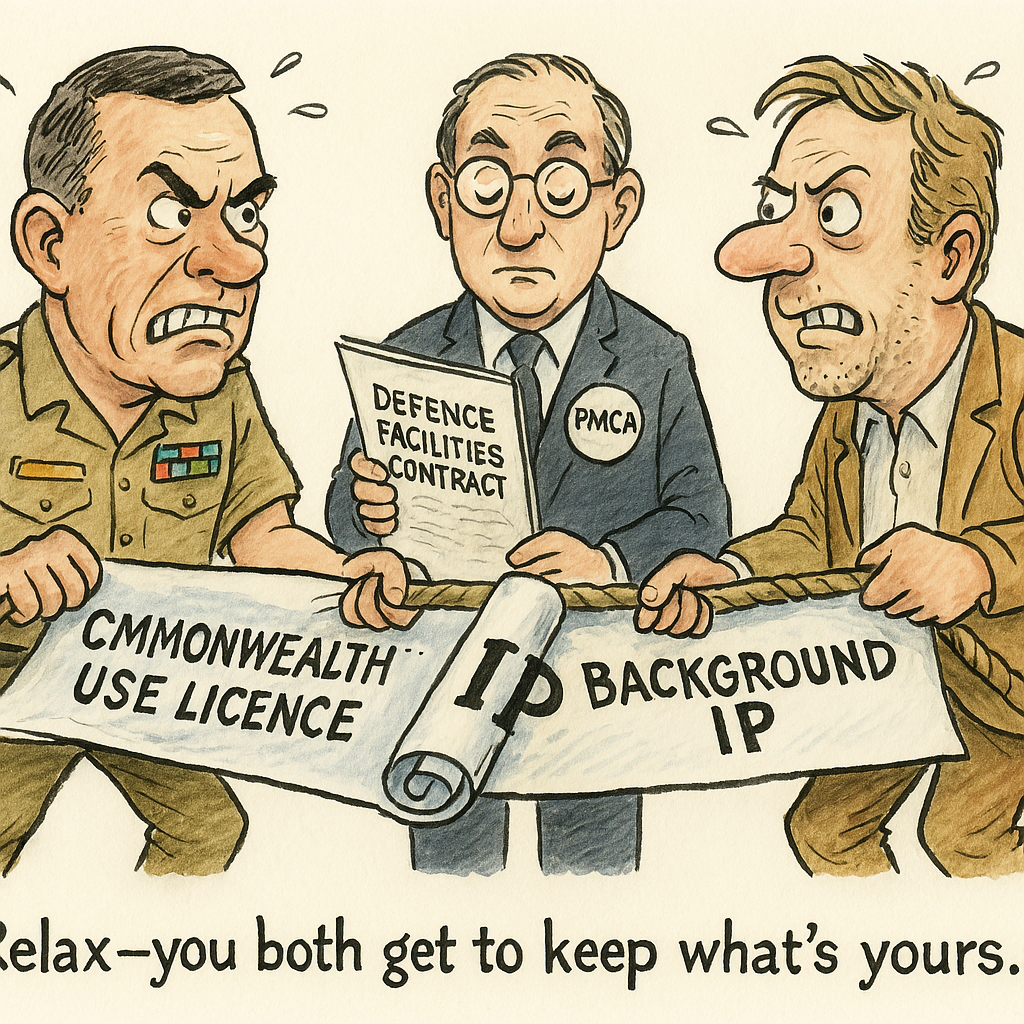
However, recent showcases and contracts suggest this is changing. Defence is increasingly acknowledging that better base infrastructure, IT facilities, and support systems can be as game-changing as a new aircraft – if not in firepower, then in enabling agility and readiness. In this post, we explore the current state of infrastructure R&D in Australia’s Defence sector, highlight three recent case studies, and examine how intellectual property (IP) clauses in Defence’s Facilities suite of contracts can either hinder or foster such innovation. We’ll also demystify key IP terms (like background IP and developed IP) in plain English, and offer practical tips for both buyers and vendors on using contracts and IP strategy to harness innovation.
The Unsung Innovators of Defence Infrastructure
Defence infrastructure projects rarely make front-page news, but they are critical to military preparedness. From deployable data centres that bring cloud capabilities to the battlefield, to novel systems that improve safety in naval ports, infrastructure-focused SMEs are delivering cutting-edge solutions. Still, misconceptions persist: many assume “infrastructure” means mundane bricks-and-mortar work with little innovation, especially compared to high-tech aerospace. In reality, Australian companies are investing in R&D to create smarter, faster, and more secure facilities – often leveraging advanced engineering, IT and even modular manufacturing techniques.
Recent industry events have shone a spotlight on this often-overlooked sector. At Avalon 2025 (the Australian International Airshow, which also features a defence expo), several exhibitors demonstrated how far infrastructure tech has come. Likewise, Land Forces 2024 (a major land defence exposition) showcased innovations not just in vehicles and weapons but in deployable facilities and base infrastructure. Even Defence procurement leaders are pushing new approaches to bring innovation into infrastructure projects – for example, at a recent Security and Estate Group (SEG) industry briefing, Defence’s Capital Facilities and Infrastructure branch announced a move to use competitive Early Contractor Involvement (ECI) models in major projects to “deliver greater value and innovation in project delivery” ([1]). All this signals that infrastructure is no longer a backwater of R&D; it’s a vibrant field where Aussie ingenuity is solving practical defence problems.
Before diving into contract and IP issues, let’s look at three real-world case studies that highlight the possibilities:
Case Studies: Infrastructure Innovation on Display
1. Datapod – Modular Data Centres for Rapid Deployment
One standout at Avalon 2025 was Datapod, a Canberra-based SME that builds modular data centre units inside shipping-container-like modules. These aren’t ordinary server rooms – they are rugged, scalable IT facilities that can be factory-built, tested, and then transported wherever needed (by truck or even military airlift) to provide instant computing power. In 2022, Datapod received a $12 million investment from Defence to ensure the ADF has access to such deployable data centres on short notice. Minister for Defence Industry Melissa Price called Datapod “an excellent example of an innovative Australian business providing rapid solutions to Defence’s changing capability needs”. The appeal is clear: instead of constructing a permanent data centre on a base (which can take years of building and fit-out), Defence can call up a Datapod unit in weeks, gaining a secure, high-performance data facility that simply plugs into power and network on site.
Such capability proved its worth when Datapod delivered portable data centres under contract – including flying units to remote locations on RAAF C-17 and even Antonov An-124 transport aircraft. The units contain all necessary components (chillers, backup generators, fire suppression, racks, etc.) in standard ISO containers and can even be daisy-chained for more capacity ([2]). At Avalon, Datapod showcased how their system can scale from a single 10-foot “Starterpod” to a larger cluster with “Expanderpod” add-ons, all managed through a “Connection Node” that links power, cooling, and data ([2]). This modular approach means Defence can start small and grow the facility as needs evolve – a flexibility traditional bricks-and-mortar builds lack. It also means assets can be redeployed: if a mission ends, the containers can be packed up and moved to the next hotspot, rather than stranded in one location. (As the Defence Sales Catalogue notes, Datapod systems “can be moved or repatriated after their initial requirement expires,” giving them decades of usable life across multiple sites ([3]).)
From an R&D perspective, Datapod’s innovation lies in adapting data centre tech to military requirements – ruggedising it for extreme climates (their pods can operate in 50°C desert conditions with no shade, as their brochure touts) and ensuring compatibility with Defence’s ICT platforms. The company’s success also highlights how Defence infrastructure innovation can overlap with the private sector: similar modular data centres are in demand for mining, disaster relief, and remote research sites. By investing in Datapod, Defence not only gets a capability edge, but also supports a product with broader commercial potential – strengthening Australia’s sovereign industrial base in ICT infrastructure.
A Datapod modular data centre unit being demonstrated. Each self-contained module houses IT racks, cooling, and power systems, and can be deployed to the field and made operational in a matter of days. Datapod’s design allows multiple modules to connect for a larger data centre, delivering scalable cloud capabilities to forward locations ([2]
2. RCR Advanced Technologies – Marine Safe Access System (MSAS)
Another example of infrastructure innovation is the Marine Safe Access Solution (MSAS) by RCR Advanced Technologies. Unveiled to Defence audiences (with support from Defence West) and featured at Avalon 2025, the MSAS addresses a very specific but vital need: allowing personnel to safely and efficiently transfer between ships and shore (or ship-to-ship) in challenging conditions. Think of it as a next-generation deployable gangway – but one that is motorised, telescoping, and stabilized so that it can adapt to waves, tides, and vessel movement, maintaining a safe link for people and equipment. RCR describes MSAS as “a new benchmark in personnel safety and docking efficiency,” engineered to work in all conditions and cut transfer times dramatically.
The MSAS is battery-powered and remote-controlled, with an ability to be set up by 1–2 people in under 10 minutes – a huge improvement over traditional methods which might involve cranes, fixed wharves, or manual gangplanks that take hours to rig and are limited by weather. By eliminating the need for cranes or heavy lifting, it also reduces safety risks and the certification overhead for working over water. The system includes an adjustable boom arm that can slew (rotate), extend, and lift to match various ship heights and dock configurations. In practice, this means a naval port (or an improvised anchorage) could deploy MSAS and quickly unload troops or supplies from a ship even in rough seas, where previously they might wait hours or days for calmer conditions.
At Avalon 2025, RCR attracted serious interest from Navy and industry for the MSAS, especially as port infrastructure becomes a focus for resilience. The company, which has a background in heavy engineering for mining and rail, invested in this defence-specific R&D and even won an innovation award for it in Western Australia. The MSAS unit is built in WA with a large in-house design team, showcasing how a cross-sector engineering company can pivot to defence needs. As an infrastructure solution, MSAS required marrying mechanical engineering with an understanding of Defence’s operational context – a great example of innovation beyond pure “military hardware.” RCR’s quad chart at Avalon highlighted the system’s compliance with relevant standards (safety, environmental) and its adaptability for different ports.
From an infrastructure perspective, MSAS could save Defence time and money by avoiding expensive pier constructions or permanent landing craft systems in certain locations. It is a portable asset – RCR notes it is “globally deployable” and can be transported to wherever needed. Importantly, RCR retains a flexible licensing model for the technology, meaning they can customize units (e.g. adding a customer’s specialized cargo loader conveyor) and potentially export the system. This is an innovation born in the defence infrastructure realm that could find civilian uses too (offshore industry, emergency ferry operations, etc.), again blurring the line between defence and commercial innovation.
RCR Advanced Technologies’ Marine Safe Access System (MSAS) in action. The MSAS is a mobile docking system that provides a stable, telescoping bridge between a ship and the shore. In the photo, the MSAS boom is extended to a naval vessel, allowing crew to disembark safely despite choppy water. The battery-powered system can be controlled by a single operator and automatically adjusts to the ship’s movement, illustrating how engineering innovation can improve safety and efficiency in defence infrastructure.
3. Manteena – Modular SCIF for Deployable Secure Facilities
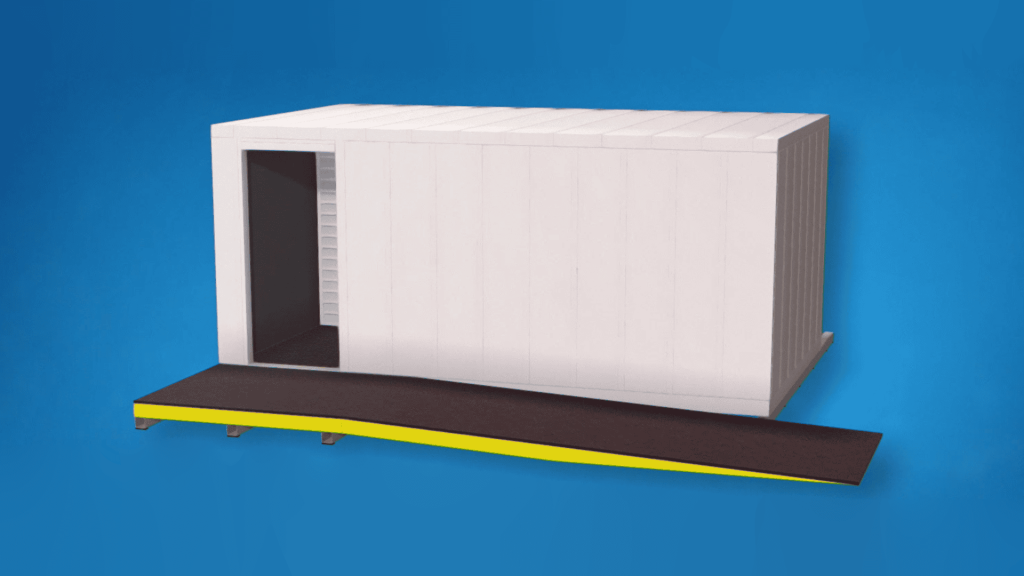
When it comes to military infrastructure, security is paramount – not just physical security but also information security. A SCIF (Sensitive Compartmented Information Facility) is a highly secure room or building where classified information can be handled. Traditional SCIFs are built into permanent facilities (think bunkers or fortified rooms in embassies). Manteena, a Canberra-based specialist construction firm, has turned this concept on its head with a Modular Secure Enclosure (MSE) – essentially a modular, deployable SCIF. Debuted around Land Forces 2024, Manteena’s modular SCIF is a Zone 5 rated enclosure (meeting one of the highest Australian Government physical security standards) that can be quickly assembled on-site from prefabricated components.
The MSE looks like a large vault-like room made of composite panels, which can be flat-packed, shipped and then bolted together inside an existing building or even in an open area. It provides a fully enclosed, RF-shielded, and tamper-evident space – meaning it can securely house classified communications equipment and personnel. According to Manteena, the system allows for “rapid deployment, short term lease, discreet installation, or minimal operational disruption”. For Defence, this means if a forward HQ or a temporary facility needs a secure communications centre, they don’t have to build one from scratch – they can assemble the MSE in days, use it as needed, then pack it up later. It’s also useful for contractors or allies operating on a Defence site: instead of granting access to a base’s permanent SCIF, a temporary one can be stood up for the project’s duration.
What’s notable in Manteena’s approach is the fusion of construction and manufacturing innovation. They treated the SCIF not as a one-off build but as a product – designed once and repeatable. It incorporates features like plug-and-play services (power, HVAC, etc.), modular walls with electromagnetic shielding (to prevent eavesdropping), and even a low floor loading so it can be installed on upper storeys of buildings without structural upgrades. In other words, it’s infrastructure as a kit. This is similar in spirit to Datapod’s modules – both allow Defence to rapidly create capabilities that normally require long construction.
At Land Forces 2024, the modular SCIF concept drew interest from Defence and industry attendees looking for ways to add secure facilities to existing sites quickly. Manteena, which has built many of Defence’s fixed high-security buildings, saw a market for a deployable solution – especially as the ADF places greater emphasis on mobility and dispersed operations. From an IP standpoint, the MSE design is proprietary to Manteena. They likely invested heavily in R&D (materials science, testing to meet security standards, etc.), and thus protect that design as a competitive advantage. However, by offering it to Defence on a project basis (either selling units or perhaps leasing them), they turn IP into a value proposition: Defence gets a cutting-edge capability faster, and Manteena retains the ability to re-use and improve the design for future clients. This dynamic is a microcosm of how innovation can flourish when IP is handled smartly – which brings us to the critical discussion of IP clauses in contracts.
IP and Innovation: Clearing the Fog on Ownership and Licensing
One reason infrastructure innovation has been muted in the past is uncertainty (and misunderstanding) around intellectual property ownership in Defence projects. Let’s break down some key terms in simple language, and see how Defence’s contracting approach affects innovators:
- Background IP – This refers to any intellectual property that a contractor (or Defence) already has before starting the project, or develops independently of the contract. In practical terms, it’s the know-how, designs, software, or patents you bring to the table. For example, Datapod’s underlying data centre designs and cooling technology are its background IP. A common misconception in Defence projects is that if a solution is used in a project, Defence “owns” it outright – not so if it was pre-existing background IP. Typically, the contractor retains ownership of its background IP; however, Defence will negotiate a licence to use it as needed for the project outcomes (we’ll discuss licences shortly).
- Developed IP (also called Foreground or Project IP) – This is the new IP that is created during the course of the contract specifically to deliver the project. For instance, if RCR, while developing MSAS for Defence, came up with a new type of sensor or software algorithm to stabilize the boom, that invention would be developed IP from the project. Contracts usually spell out who will own developed IP. Contrary to what some might expect, Defence does not always take ownership of developed IP by default – often the contractor will own it, or at least have the right to fully exploit it elsewhere, while granting Defence certain usage rights. The logic is that the contractor is best placed to further develop and commercialize that IP (especially if it has civilian applications), which can ultimately benefit Defence too through a stronger supply base.
In Defence’s modern contracting templates (like the ASDEFCON suite used for procurement), the approach to IP is usually “retain ownership, grant licence” rather than outright Commonwealth ownership, except in certain sensitive cases. Defence typically “demands licences to the IP underlying a supplier’s products” for Defence purposes ([4]). What does that mean? It means if you build something for Defence, you must allow Defence to use it freely for Defence activities (which can include sharing with allies, since that is still a defence purpose) ([4]). In return, you as the contractor often get to keep owning the IP and can reuse or sell it in other markets (as long as that doesn’t conflict with security or export controls). For example, Manteena can deploy its modular SCIF to multiple clients; the Commonwealth doesn’t claim exclusive rights to that design, but if Defence buys one, it can use that unit and modify it for its needs. Similarly, Datapod retains its designs but Defence gets assurance that it can operate and maintain the data centres for any Defence use, and even have them modified by third parties if Datapod went out of business – that’s covered by the licence and related technical data rights.
However, problems arise when IP clauses are misunderstood or made overly grabby. Some Defence officials in the past held the view “we paid for it, so we own it.” Industry anecdotes unfortunately abound of local SMEs being told by Defence contract managers that because Defence funded prior contracts, “we should own it [the IP]” ([4]). This is a misconception – payment for deliverables is not the same as buying all underlying IP rights. Such attitudes, when baked into contract demands, can hinder innovation. Why? Because an SME like Datapod or Manteena will be very hesitant to invest its best R&D into a project if the result is that they lose control of the IP and thus their competitive edge. If Defence insisted on owning the modular SCIF design outright, Manteena would essentially create a product and then lose the ability to sell it to anyone else, severely limiting their incentive (and perhaps their legal ability) to innovate further. Innovation thrives on the ability to commercialise IP across multiple customers – that’s how companies recoup R&D costs.
Defence seems to recognise this balance. The current Defence Facilities contracting suite (the set of standard contracts for construction and infrastructure) includes IP clauses that generally license IP to the Commonwealth for broad use, but stop short of confiscating ownership. For example, the Commonwealth will typically receive a licence to use, reproduce, and modify the “Contract Material” (things like designs, specifications, as-built drawings) for any Defence purpose. This ensures that if Defence needs to expand a building or repair the facility, it can do so even if the original contractor isn’t around. Importantly, these licences often allow Defence to sublicence the IP to others for Defence purposes (e.g. to hire another company to do maintenance using the original designs). From the contractor’s side, such clauses also usually preserve the contractor’s rights to their background IP (they just grant Defence a needed-use licence) and allow the contractor to use the developed IP elsewhere after fulfilling the contract.
One area to watch is the definition of “Defence Purpose” in these licences. It’s generally meant to confine Defence’s use of the IP to its own operations, not commercial exploitation – but as industry observers point out, for many defence-specific technologies, any meaningful use is a Defence (or allied Defence) use ([4]). That nuance aside, the key takeaway is that well-crafted IP clauses can foster innovation by aligning incentives: the Commonwealth gets what it needs (the ability to use and support the innovation in service), and the contractor retains the ability to further profit from and develop the innovation in other contexts. This way, both sides benefit from the IP. Indeed, Defence has even reformed its policies in recent years via an Intellectual Property framework to streamline procurement and give clarity on IP rights ([5]), acknowledging that confusion or overreach in IP can scare off suppliers.
To put it simply, if Defence wants industry to bring its A-game innovations, it can’t “steal” the playbook. Requiring a non-exclusive, Defence-only licence is usually sufficient. Owning the IP outright might occasionally be necessary (say, for secret or unique sovereign capabilities with no commercial use, or if a supplier is dissolving), but those should be the exceptions, not the rule. By and large, infrastructure projects follow the licence model, which is a positive for innovation. The upcoming challenge is educating all stakeholders – project managers, legal officers, contractors – so that misconceptions (like assuming Defence automatically owns design IP for a building it paid for) do not derail collaborative innovation.
Making Contracts Work for Innovation: Tips for Buyers and Vendors
The interplay of innovation and IP ultimately comes to a head when drafting and evaluating contracts. Both Defence as the buyer and industry as the vendor have roles in ensuring projects encourage rather than stifle new ideas. Here are some practical strategies:
For Defence buyers (project directors, procurement officials, contract managers):
For industry vendors (contractors, SMEs, innovators):
Conclusion
Infrastructure innovation in Defence is finally stepping into the limelight – and rightly so. The case studies of Datapod, RCR’s MSAS, and Manteena’s modular SCIF demonstrate that Australian companies can deliver world-class innovation in the enabling systems that keep the ADF running. These aren’t just incremental improvements; they are transformative capabilities (be it setting up IT infrastructure in days, making any port a safe berth, or deploying a secure facility on demand). Such breakthroughs are possible when creative engineers, forward-thinking Defence buyers, and sensible contracting come together.
A recurring theme is that intellectual property arrangements make a huge difference in this space. Infrastructure projects have often been seen as bespoke one-offs, but the moment we treat a deployable data centre or modular building as a product with IP value, we unlock economies of scale and ongoing development that benefit all parties. Yes, navigating IP can be complex – but the answer is not to avoid it or strong-arm it; it’s to manage it through clear licences, mutual respect for each other’s contributions, and alignment of incentives. As we’ve discussed, Defence’s Facilities contracts can either be a roadblock or a springboard for innovation. The trend is thankfully towards the latter: licensing frameworks, ECI models, and industry engagement initiatives are creating a more innovation-friendly ecosystem.
For Defence infrastructure project managers, consultants, and business developers reading this: the next time you’re involved in a new project – say a base upgrade or a new facility requirement – take a moment to ask, “Is there an innovative way to do this, and how can we enable it?” Scan the market for SMEs like those above; consider soft-market testing or innovation workshops. When drafting that contract, don’t reflexively copy-paste clauses without thinking about their effect on an SME’s willingness to propose a novel solution. And for vendors, don’t hold back proposing a great idea out of fear that Defence will ‘take it away’ – the landscape is shifting, and Defence wants innovation and is increasingly prepared to partner on fair terms.
In the end, the Australian Defence Force gains a double dividend: cutting-edge infrastructure capabilities for itself, and a stronger local industry base that can also thrive commercially. The under-recognised role of infrastructure innovation is getting its due recognition. By continuing to refine how we handle IP and procurement, we can ensure that the best ideas find their way from Australian workshops and labs into the Defence estate – and do so faster, cheaper, and smarter than ever before. That is a mission worth pursuing for everyone involved.
References
[1] – DECnet (Defence Estate Community) briefing – introduction of competitive ECI model to drive innovation https://www.linkedin.com/posts/decnet_defenceestate-procurement-innovation-activity-7270949291106398210-dWHm
[2] – Datapod modular data centre capabilities (expandable containerised units) https://www.itnews.com.au/news/photos-inside-datapods-container-data-centres-153235
[3] – https://www.aeropm.net/uploads/1/1/8/6/118630415/australian-defence-sales-catalogue-2020.pdf
[4] – AIDN “IP Paradox” – discussion of Defence IP licensing vs ownership stance https://aidn.org.au/the-ip-paradox/
[5] – https://www.defence.gov.au/business-industry/procurement/policies-guidelines-templates/procurement-guidance/intellectual-property-framework
[7] – RCR Advanced Technologies – MSAS features and benefits https://youtu.be/1YfCCJ87SX8
[6] – Manteena – Modular Secure Enclosure (deployable SCIF) overview https://www.manteena.com.au/mse/

Author: Darian Macey
Darian is a former Engineering Officer with the RAE with tertiary qualifications in Engineering and Project Management. He is a leading practitioner within Australia's NSI sector with previous employment in Government, project management and building contractor organisations.